EPDs document the carbon footprint from Troldtekt acoustic panels
In August 2025, EPD Denmark published new environmental product declarations (EPDs) for Troldtekt's acoustic panels. The EPDs document, among other things, the carbon footprint (Global Warming Potential) across all life cycle phases of the panels. By choosing Troldtekt based on the cement type FUTURECEM™, you achieve a 40 per cent lower carbon footprint than with Troldtekt based on traditional white cement.
In just a few clicks, developers, consultants and installers can find the carbon footprint for different variants of Troldtekt acoustic panels. This is useful when preparing life cycle analyses (LCAs) for building projects.
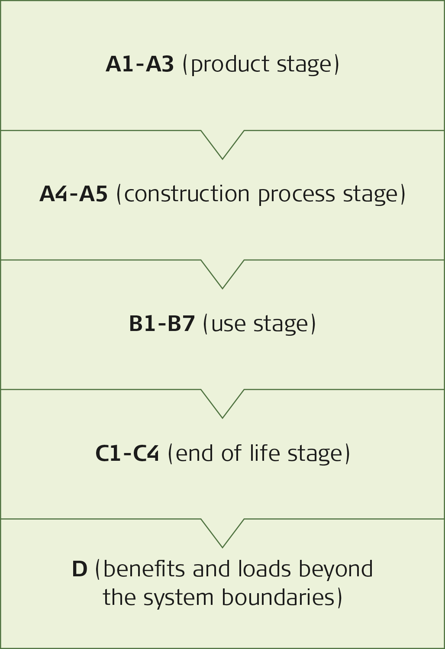
Troldtekt's EPDs are prepared in accordance with standard EN 15804+A2 and cover the following phases:
FUTURECEM leaves the smallest footprint
One of the key pieces of information in the carbon EPDs is the carbon footprint per square metre of Troldtekt acoustic panel – known as Global Warming Potential (GWP). You can see the total carbon footprint for two different variants of Troldtekt acoustic panels in the graphs. Both panels are shown in an unpainted and a painted version.
The raw material cement has a significant impact on the overall carbon footprint of the panels, and you can achieve the lowest footprint by choosing Troldtekt panels based on the cement type FUTURECEM.
- > When you choose unpainted Troldtekt based on FUTURECEM, the footprint is 36 per cent lower than for unpainted Troldtekt based on traditional white cement.
- > When you choose painted Troldtekt based on FUTURECEM, the footprint is 34 per cent lower than for painted Troldtekt based on traditional white cement.
Scroll to the right to see the graph for painted Troldtekt panels.


What's important to know when reading the graphs
EPDs for two basic panels: The two unpainted basic variants of Troldtekt acoustic panels each have their own EPD. If you are use painted panels, the paint's footprint must be added to the reported figures as illustrated in two of the graphs shown here. The number you need to add can be found in the EPD. The paint's footprint has been taken from our paint supplier's EPD.
Applies to 25 mm Troldtekt panels: The two EPDs apply to all panels with a thickness of 25 mm. If you use panels with a thickness of 35 mm, you need to convert using the factor specified in the EPD.
Divided into phases: The carbon footprint is calculated for each phase from A to D. In some phases, the footprint is negative, while in others it is positive. The total is presented as a single value indicated by the orange dot in the graphs. Read more about each phase in our guide on the use of EPDs.
National regulations apply: When calculating a building’s life cycle assessment (LCA) in accordance with national regulations, you must also be aware of which EPD phases are included. Typically, phase D will not be included in the LCA calculation. Read more about the regulations in our guide to using EPDs.
Calculated over total service life: In the EDPs, the carbon footprint of Troldtekt acoustic panels is calculated per square metre over a total service life of 50 years. In some countries, such as Denmark, it is standard practice to convert this to an annual carbon footprint. If you choose an unpainted Troldtekt panel based on FUTURECEM and exclude phase D, the annual footprint per square metre is 0.1002 kg.
Reduction from cement
Compared to Troldtekt's previous EPDs from 2021, the carbon footprint for both basic panels has decreased. The EPDs from 2025 show:
> a 12 per cent lower carbon footprint for Troldtekt in natural wood, which is based on white cement
> a 20 per cent lower carbon footprint for Troldtekt based on the cement type FUTURECEM™.
Troldtekt acoustic panels consist of wood and cement and, at the Troldtekt factory in Troldhede, 98.3 per cent of energy used in production originates from renewable sources. In 2021, this figure was already 97.8 per cent.
The reduction in CO2 emissions between 2021 and 2025 has therefore mainly occurred in the production of externally sourced cement. There have been reductions for both the white cement included in the panels available in natural wood and for FUTURECEM, which is included in all other panels.
Three end-of-life scenarios
In addition to the lower carbon footprint, the EPDs have been updated in a number of areas since the 2021 versions. For example, construction waste has been included in phase A5 and the conditions for product transport from Troldtekt's factory to the building site have been adjusted in phase A4. The average transport distance has increased.
Furthermore, CO2 figures can now be selected for three different end-of-life scenarios once the panels have reached the end of their service life:
> Incineration (main scenario in Denmark, where Troldtekt has its production)
> Landfill
> Recycling crushed panels in the biological cycle.
Landfill disposal results in a higher carbon footprint than the main scenario, while recycling results in a lower footprint.
Independent verifiers
The EPDs are published by EPD Denmark and can be imported directly into the digital tool LCAbyg, which consultants often use to calculate the total environmental footprint of a building's life cycle.
The life cycle analyses themselves were prepared by Stefan E. Danielsson, who is an independent verifier affiliated with EPD Denmark. The EPDs have been third-party verified by one of the other independent verifiers affiliated with EPD Denmark.
Also read our guide to using EPDs in building projects